Viewers of NBC News on Sept. 22 were treated to some spectacular claims about artificial objects that might have been in orbit around the earth before Sputnik. Dr. Beatriz Villarroel repeated her now-viral claims about 'vanishing stars' - stars that appear on a red-sensitive photographic plate, but not in the blue-sensitive one. As if this were something remarkable.
 |
Dr. Villarroel provided images to NBC News from the Palomar Sky Survey, showing stars on a Red Plate, and the same stars on a Blue Plate. Some of the stars are missing on the blue plate! Wonder of wonders!! |

Dr. V. has circled some 'missing stars' between the Red and Blue plates, which she assumes to be mysterious objects orbiting the earth before Sputnik. Does she expect the objects on the two plates to otherwise be the same? If so, why did astronomers even bother to photograph star images in two different colors?
Frankly, anybody making this claim does not understand why two different color plates are used in the Sky Survey.
It is not to add color or sparkle to the effort. Rather, it is to measure a star's relative brightness in two different colors, which gives us its color index, and hence its temperature and spectral class. Indeed the color of a star is determined by its relative brightness on each plate. That is why two different colors are used. Astronomers want to determine the "Color Temperature" of a individual star, which reveals a lot about the star's makeup. The astronomer measures the apparent brightness of a star in red and blue light. Then the calculation of B-V (blue minus red) brightness tells us what spectral class this star belongs to. The image below illustrates why astronomers took images of star fields using two different color-sensitive plates.
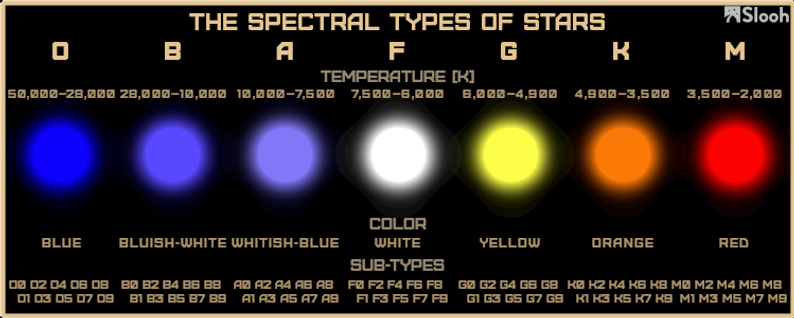 |
| Stars have colors,which in turn tells astronomers its temperature (from Slooh). |
A star that is very red (Type M) will shine brightly on the red-sensitive plate, but may not show up at all on the blue plate, while the very blue stars (Types O, B, and A) might not be seen in the red. That's how the sky survey works.

The 18 1/2 inch Alvan Clark refractor at Dearborn Observatory, from 1860.
Way back when I took astronomy classes at Northwestern University, we learned the fine art of using glass plates for astrophotography, using this venerable 19th Century gem, the 18 1/2 inch Alvan Clark refractor at Dearborn Observatory (and yes, this class was taught by J. Allen Hynek). Nobody uses glass plates any longer, today it's all electronic imaging (which of course did not exist almost 60 years ago). Below is an image of the famous Hercules Cluster (M13) I took on a glass plate circa 1969, using the Alvan Clark refractor. What look like scratches on the plate are in fact alien space probes.

So, enough of this nonsense about 'missing stars!!'


Did you get your 7000 Shmeckles for this post?
ReplyDeleteNo, the bastards only gave me 5000 Schmekles.
DeleteIf you read Villaroel's paper, they only consider something a red transient if it is not present in later red plates of the same sky region (this is the "transient" part). I share your skepticism of the UAP explanation given that there are so many other possibilities, and that the obvious-seeming explanation of a defect in the plates has only arguably been ruled out. But I think it's a bit unkind to think that these astronomers just don't understand that the objects might be red, the original VASCO paper explicitly discusses that possibility.
ReplyDeleteIf we assume that the objects don't appear in the blue plate because they are of such low magnitude in the blue to not be visible at all, which is reasonable, all that changes is that the objects (if they are objects at all and not defects) must have dimmed over the span of two months (in the case of the prominent "triple transient" example, the time period before the next red plate of the same region was taken) rather than an hour.