Monday, March 28, 2022

Jacques Vallee's " Invisible College" Teaches "Metalogic."

This is the review I wrote of  The Invisible College by Jacques Vallee, appearing in The Zetetic (which later became The Skeptical Inquirer), Spring/Summer, 1977. The first part of my review, “The Edge of Reality” by Hynek and Vallee, is found here, I recently added to it Hynek's reply to me, and mine to him (which in the original publication was at the end, after both reviews.). If you read that posting before this one was published, I suggest you go back to read Hynek's reply.

The Invisible College: What a Group of Scientists Has Discovered About UFO Influences on the Human Race. By Jacques Vallee. E. P. Dutton, New York, 1975. 223 pp. $8.95.

Reviewed by Robert Sheaffer


The Invisible College is best read sitting down, with seat belts firmly in place. If Jacques Vallee, in collaboration with J. Allen Hynek, can produce The Edge of Reality, then this book of undiluted Vallee can only be titled “Beyond the Brink.”

Be prepared to meet Ummo, the inhabitants of the solar system of Wolf 424 (a red-dwarf star, believed to be incapable of supporting habitable planets), who cruise around in their Oawolea Ouewa (lenticular spacecrafts). You will also meet 7171, a UFO entity who is in frequent telepathic communication with a terrestrial medium, and Oeeu, the “Universal Association of Planets,” a sort of cosmic United Nations. Vallee takes these stories seriously. Most UFO investigators take Vallee seriously. That fact alone suffices to keep the present writer from taking UFOs seriously.

Monsieur Vallee, computer scientist, astrophysicist, and member or the scientific board of Hynek's Center for UFO Studies, has a unique way of looking at the universe. It's called “metalogic.” For those or us not familiar with that term, he explains that it means quite the same thing as “absurd.” So should we protest that Vallee's theories are “absurd,” he will correct our usage: they are merely “metalogical.” That's the next level above common sense, just beyond the “edge of reality.” UFO skeptics are wrong, Vallee would say, their theories objectively false. The UFO evidence allegedly proves that, in a manner that even Aristotle would find quite satisfactory, Quod erot demonstrandum. But Vallee's exquisite theories are not to be evaluated on such a vulgar level. They are metalogical—not precisely true, but certainly not false either, not in the same sense that UFO skeptics are simply wrong. UFOs, Vallee informs us, are “truer than true” (emphasis in original). Should anyone reading this actually understand what it means, it is urgent that you contact Vallee at once. There will then be two of you.

The metalogic truly represents the greatest advance in scientific philosophy since the invention of the Dialectic, which enables devout Marxists to “prove” that the Proletariat can only be liberated by being locked up in Gulag camps. One cannot get by with ordinary logic if one wishes to believe all the incredible things that Vallee does, so he rejects logic itself instead of rejecting Ummo, Oeeu, and the like. If the UFO evidence doesn't make sense, so much the worse for sense. Watching Vallee, who calls himself a scientist, so cavalierly jettison the objective, nonmystical world-view of science, one cannot help but wonder how far he might go were he to become an avowed mystic.

Spectra is the name given to the mysterious space entity which is alleged to beam down to Uri Geller the “paranormal” powers that enable him to do the things that stage magicians can do without them. Vallee has met Mr. Geller, and was most impressed by the apparent authenticity of his “paranormal” abilities. (I wonder if Vallee has ever met James Randi?) Geller's supposed revelations from the UFO-beings of Spectra of course fascinate Vallee, but he is not blind to the absurdities and contradictions in their messages; he recognizes that they are “telling obvious falsehoods and uttering sheer jargon most of the time.” Does this damage Geller's credibility in Vallee's eyes? hot at all: “I think highly of Geller's talents. We cannot brush aside [his] experiences ... with simple rejections. What we can and should do is to sort out the implications of the extremely confusing set of events (they claim] to have observed.” It appears that Geller's tales are simply too absurd for Vallee to reject. Hence they must be true, in some metalogical sort of way.

Vallee at Northwestern giving a talk
on computer science (about 1969)

A policeman in Nebraska was supposedly abducted by a UFO in 1967. The UFO occupants reportedly gave the patrolman “a lot of interesting but possibly misleading information. They wanted him to believe that they came from a nearby galaxy. They had bases in the United States. Their craft was operated by reverse electromagnetism.” Even Vallee finds it difficult to believe these things! Does he reach the obvious and straightforward conclusion that the witness is either hoaxing or else has hallucinated the incident? Certainly not. Vallee designates this aspect of absurdity “The Third Coverup.” It represents “the built-in silencing mechanism of the phenomenon itself.... The phenomenon negates itself. It issues statements and demonstrates principles where some of the information conveyed is true and some is false.” UFOs, he says, deliberately make themselves absurd to keep us from taking them too seriously. That line of reasoning can, of course, be utilized to justify absolutely any absurdity at all. One would hope that Vallee might look past the obvious immediate advantages to see the long-range problems that would arise if other scientists were to follow his lead in constructing hypotheses that can never be proven true or false.

The only thing wrong with Vallee's metareasoning is that, if adopted as a legitimate scientific paradigm, it would mean the end of experimental science. No one could ever prove or disprove anything. Science is a fully consistent body of knowledge; if metalogic is a valid methodology for analyzing UFOs, it must likewise be applicable to astronomy. Well, I say the earth is flat, and it rests on the back of a turtle. Don't say that's absurd—it is metalogical. Don't trot out evidence to show that I'm wrong, for contradiction is one of the ways in which the Great Turtle manifests the phenomenon. My flat-earth hypothesis is truer than true. Don't say that my theory is unscientific because it is impossible even in principle to prove it wrong, because Vallee's wild UFO speculations are likewise safe from the potential challenge of any critical experiment. In short, in The Invisible College we find nothing less than a complete and explicit rejection of the scientific method. Its rigorous standards of evidence are incompatible with the charming stories of miracles, little people, and mystical visions that Vallee wishes to weave into his UFO tapestry.

Vallee does indeed reach a conclusion about UFOs which presumably follows directly from his metaevidence. It is not immediately clear that conclusions of any kind can be drawn if one rejects “our laws of causality” (in Vallee's colorful phrase), but apparently even the Great Trailblazer was unable to make a clean enough break with his past to outgrow the childish habit of seeking conclusions from the evident in hand. His conclusion is that UFOs form a “control system” for human consciousness: “they are the means through which man's concepts are being rearranged.” How and why we are being “rearranged,” and by whom, he is unable to say; whether by Affa, Ummo, Ankar, Oeeu, or Spectra is left for the reader to decide.

What. by the way, is The Invisible College? It is a loose federation of scientists who are carrying out their own investigations into the UFO phenomenon, even though UFO research is not (“as yet,” as they say) a recognized scientific field. (Very little of the book deals with the College: miracles and metalogic predominate.) The present-day Invisible College takes its name from a seventeenth-century group of scientists that met informally, even clandestinely, at a time when the established colleges were dominated by the fossilized doctrines of antiquity. As experimental science gradually became respectable, its practitioners crawled out of hiding. Vallee-style UFOlogists like to think that they, too, are far ahead of their time, and that someday their ideas will likewise be vindicated by history.

But the original Invisible College was made up of scientists who were rebelling against the very sort of mysticism that Vallee is seeking to bring back. They were followers of Francis Bacon, the arch-experimenter, who advocated. that scientists “put nature on the rack and compel her to bear witness.” Bacon would have been acutely uncomfortable in the presence of a metalogic.

Bacon also left his followers a sober warning, which the latter-day invisible college might do well to heed: “In general let every student of nature take this as a rule—that whatever the mind seizes and dwells upon with peculiar satisfaction, is to be held in suspicion.” 

Methinks that the members of today's Invisible College might show just a trifle more suspicion in analyzing reports of bizarre UFO encounters.

Jacques Vallee comments:

I have but few comments, since the reviewer has misunderstood both the spirit and the letter of the book to the point of assuming that I believed there were such planets as Ummo and Spectra, when a great deal of my time is spent precisely in exposing the contradictions of contactee stories. The only inaccuracy I would like to correct for the record has to do with the Center for UFO Studies, with which Sheaffer believes I am still associated. In fact I resigned from the scientific board of CUFOS over a year ago and am not currently associated with any UFO groups. To relieve the dullness of this whole subject I would like to share with you and your readers the epitaph I have composed following the death of Professor Donald Menzel, to whom we owe many definitive explanation of the UFO phenomenon. I have written it as a limerick:

There once was a dead man with a final answer
To strange things in Heaven, but as he got closer, He did meet an angel,
Who said, “Dr. Menzel,
Why are you flying so, Sir?"


Wednesday, February 2, 2022

Drs. Hynek and Vallee Totter on the Edge of Reality!

( Revision March 27, 2022: I have moved Hynek's reply here. Vallee's reply is in the second part.)

Now that Jacques Vallee is back in the news (again) after being selected to join Dr. Avi Loeb's Galileo Project, it's instructive to review some of his earlier writings. Researcher Curt Collins points out that Vallee has been named to Galileo's "Research Team," which is higher than being a mere "Research Affiliate" like Galileo's other UFOlogists (Luis Elizondo, Nick Pope, Chris Mellon, Robert Powell, Gary Voorhis.). Did you see how many people are now listed on the Galileo web pages, in various positions? I didn't count them, but I was surprised to find dozens!

I had two book reviews published in the Spring/Summer, 1977 issue of The Zetetic (later to become The Skeptical Inquirer): this one by Hynek and Vallee, and Vallee's The Invisible College, which is in a later posting here.

Make no mistake, it was always Vallee pulling Hynek to be farther and farther out, rather than the other way around.


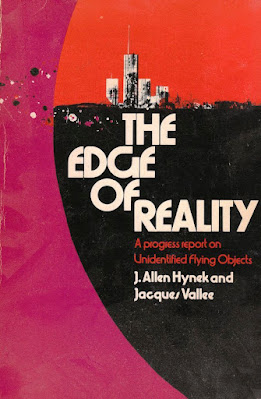
                              The Edge of Reality: A Progress Report on Unidentified Flying Objects.
                              By J. Allen Hynek and Jacques Vallee. Henry Regnery Co., Chicago, 1975.
                             301. pp.  $14.9S cloth, $5.95 paper.

                              Reviewed by Robert Sheaffer  (The Zetetic, Spring/Summer, 1977)

It is not often that one encounters a book written by two trained scientists that promises to take one to the very “edge of reality.” Such voyages of course are daily occurrences for those who dwell in the murky meta-regions of the occult, but it represents a dark, uncharted path for those who have been trained in the exacting methods of the physical sciences. Thus one is not surprised to see that authors J. Allen Hynek, a Northwestern University astronomer and former Air Force UFO consultant, and Jacques Vallee, a computer scientist who also holds a degree in astrophysics, view themselves somewhat as pioneers. The book opens with a stern warning to those who find all new ideas “both frightening and a threat to their intellectual security” (this of course being the only possible reason anyone might disbelieve in UFOs). Their aim is to become Galileo, Einstein, and Daniel Boone rolled up into one, to “open up entirely new vistas” on an unseen universe. Indeed nothing less than a whole new universe awaits us, for it is the authors' modest intention to show how UFOs, ESP, and out-of-body travels are “signaling that there's a reality that the physical scientists... aren't at all conscious of, but exists!”
 
One might expect that physical scientists would approach such a wild, untamed region with infinite caution. If so, one will be disappointed, for the authors have gleefully swallowed a dismally high number of UFO hoaxes. Of the reported UFO abduction of two Mississippi fishermen in 1973, Hynek asserts, “The men are not lying. I’m quite convinced of that” [emphasis in original].  Then why did the principal witness back down, at the last possible moment, from his public promise to take a lie detector test while at a UFO conference in 1975? This promise was only reluctantly given after UFO skeptic Philip J. Klass revealed that an earlier polygraph test, which the witness had apparently passed, had in fact been a twenty-minute “quickie” job, conducted by an unlicensed, uncertified operator brought in from out of state. Never mind such details: the witness had “passed a lie detector test,” and that's good enough evidence for Hynek.

The alleged UFO photos taken at McMinnville in 1950 are included in the book as apparently authentic, despite the fact that the witnesses have been shown to have falsified the time of day at which the photos were supposedly taken. The alleged “paranormal” powers of UFO contactee Uri Geller, the Israeli Cagliostro, are cited as compelling evidence for the reality of that fantasy land supposedly lying beyond “the edge,” despite the demonstrations of James Randi and others that Geller is just a clever fraud. And both authors are convinced of the authenticity of the supposed UFO landing which occurred in Kansas in 1971, even though the principal witness subsequently reported sighting, among other things, “the Wolf Girl.” One is left with the feeling that were Hynek and Vallee to invest in real estate, their first purchase would likely be the Brooklyn Bridge.

The authors are anything but timid. (Even the format of the book is unconventional: most of it consists of transcripts of the authors’ conversations.) They do not attempt to shy away from the obvious internal inconsistency of the UFO phenomenon, as “scientific” UFOlogists usually do. Instead they meet the absurdity head-on. Vallee concedes that the UFOs’ reported behavior “is not consistent either with what you would expect from space visitors, or with what we know about physics. That's the dilemma.” How to resolve it? Simple: first, we hypothesize that UFOs are coming from somewhere outside of space (?), and then we do away with physics.

With that dilemma nicely disposed of, Hynek enjoys telling tales about the “paranormal” feats of a Sioux Indian Medicine Man, which a friend of his has heard about while visiting an Indian village. Vallee prefers talking about elves and Elementals, and the Black and Red Meu, which can only be seen by his three-year- old daughter. Vallee confesses that he once thought the Men, who live in haunted houses and play with ghosts, to be just childhood fantasies. But apparently the findings of his UFO research are now no less bizarre than his daughter's invisible companions. Anything goes when your working hypothesis becomes “interpenetrating universes.” The authors can justifiably feel proud of their work, for they have succeeded in formulating the ideal  scientific hypothesis: no matter what may be discovered in the future, their “parallel universe” scheme can never be refuted!
 
Vallee and Hynek likewise directly confront the tricky question of how UFOs always manage to slip away before the evidence of their existence becomes too convincing. “Close encounters” with UFOs seem to take place in isolated areas, and the supposed “physical remains” of their visits are always inconclusive. Photographs are never clear and convincing, and invariably only one photographer is present. If UFOs were in fact real objects, given the large number of reported sightings, it is inconceivable that conclusive evidence of their existence would not have been obtained by this time. Hynek has an answer to that objection: “The UFO is what has been termed a ’jealous phenomenon.’ " (So termed by whom? By this reviewer. I introduced the idea to Hynek while I was a student at Northwestern.) “A Boeing 747 is not a jealous phenomenon, an eclipse isn't jealous, anyone can observe it. But a UFO is a 'jealous phenomenon’ in that it seems to be localized in space and time.” And thus another troublesome problem has been disposed of, in the finest Medieval fashion: as soon as a name has been invented to cover some puzzling observation, the explanation has been completed. Hynek chooses to ignore the argument I presented in explaining the significance of this concept: when a phenomenon appears to be “jealous,” like UFOs, ESP, and the Bigfoot monster, playing peak-a-boo with the world of objective reality, that is the strongest possible indication that it exists only in the overheated imaginations of its investigators.

The Edge of Reality is riddled with errors of fact, many of them small, but they nonetheless reveal the authors' uniquely careless scholarship. Everyone who reads the book seems to find a few more. For example, the authors state that “years go by without a single [airplane] crash.” Philip J. Klass looked it up: there has been at least one fatal airline accident in the United States in every recent year, a total of 24 in the past five years. Aerospace writer James Oberg thought it curious that Mercury 9 should be launched before Mercury 8, which it must have been if the book's chronology of “astronaut UFOs” is correct. Tape recordings are said to be “in the Library of Congress” when in fact they're not. And the director of Dearborn Observatory in 1897—George Washington Hough, Hynek's own predecessor—was not its first director, as is stated. Is this the kind of scholarship that is expected to convince us to revise our concepts of the very nature of the universe?
 
Of UFOlogical skeptics Hynek says, “Heaven knows we need them to keep a proper balance.” By this standard the Center for UFO Studies, of which Hynek is the founder and director, is an organization badly out of balance, for not a single UFO skeptic is to be found among its principal investigators or on its scientific board. Peas in a pod jostle each other more than does this like-minded crew. The authors' disdain for critical opinion is openly stated elsewhere in the book:

Vallee: Do we have to give a day in court to the man who believes it's all nonsense? Hynek: Hell! One could spend all his energy confronting skeptics.... Why waste time on people who have not bothered to learn the basic facts? It's their problem!
Hynek at Northwestern about 1970
(photo by author).


To categorize all UFO skeptics, including such experienced investigators as the late Donald Menzel and Philip Klass, as “people who have not bothered to learn the basic facts” is nothing short of an outrageous falsehood. Hynek should publicly apologize for having so recklessly published such foolish charges. Here we see the unstated principle upon which the “scientific” UFO Center operates: Responsible criticism does not exist. Questions and disagreements are invariably ignored. Letters from responsible (but unwelcome) individuals remain unanswered. Results of UFO evaluations are never publicly released. (Why give out such information to just anybody?) Thus the operation of the center has come to closely resemble the astrophysicists’ conception of a Black Hole; no matter how much material falls into it, nothing ever escapes. Yet the authors brazenly accuse all the other UFO groups of “actually hiding information instead of revealing it"! “They're publishing just enough to titillate the interest of their subscribers,” charges Hynek, whose group publishes virtually nothing at all, while imploring its subscribers to become patrons at a thousand bucks a throw. “They turn into a PR organization,” says Vallee of every UFO group except his own.

No meeting or conference organized by the Center for UFO Studies has ever included a single skeptic's dissenting voice. (Is the pro-UFO position utterly indefensible?) The house of cards Vallee and Hynek have built upon a foundation of hearsay evidence, careless scholarship, and neglect of scientific methodology would quickly tumble down in the turbulent air of open scientific debate. Having taken such pains to isolate themselves from all responsible criticism, it is not difficult to see why the authors now totter so precariously on the “edge of reality.”
 
J. Allen Hynek comments:

There are several kinds of book reviewers: those who review a book in terms of their own expertise in the subject, thus giving the reader a rewarding and intelligently critical perspective; those who lack this expertise and resort to picking out irrelevant discrepancies (“On page 178 Jones states that Jefferies visited Patagonia in 1923; it was 1924!") just to prove that they read the book (at least page 178); and those who use the review as a vehicle for airing their own opinions and strong emotional bias, with little reference to the main thrust of the author's work. Sheaffer is a good example of all but the first of these.

Sheaffer's concern seems to be that the book is not a definitive work on UFOs. He fails to recognize the primary nature of the book: a conversation between two people who have devoted far, far more time than the reviewer to the subject, and who are themselves by no means in agreement on many aspects of the problem. The Edge of Reality was meant to be controversial, and even deliberately “visionary"; to exhibit the many sides of the problem of dealing with the phenomenon of UFO reports, whose existence no one can deny; and indeed, to parade to public view the authors' own puzzlement about UFOS. It was not intended as "UFO truth once and for all revealed."

Sheaffer has always totally ignored the continuing flow of truly puzz1ing UFO reports, from all parts of the world and in many instances from remarkably competent witnesses. He still undoubtedly be surprised by the results of Dr. Sturrock's recent survey of the membership of the American Astronomical Society on the subject of UFOS (Peter Sturrock, Stanford University Institute for Plasma Research Report No. 681), which points out that 53 percent of the respondents to the questionnaire (52 percent of  the  questionnaires were  returned)  indicated  a positive attitude toward the scientific study of UFO reports, and which also contains a few interesting UFO reports made by professional astronomers!

The reader will discover that Sheaffer has learned well at the feet of his master, Philip Klass, the not-too-gentle art of using argumenti ad homini: “Their aim is to become Galileo, Einstein, and Daniel Boone all rolled into one” is a most uncalled-for remark. Further, his charge that we “have gleefully swallowed a dismally high number of UFO hoaxes” is certainly not demonstrable. Hoaxes by whose standards? Is Sheaffer unaware of Dr. Bruce Maccabee's work on the McMinnville photographs (see the Proceedings of the 1976 CUFOS Conference, Center for UFO Studies), which showed from careful photometric study that the strange object had to be at a considerable distance from the camera? Also, what about the utter lack of substantiation of Klass's claim that Socorro was a hoax contrived by the Chamber of Commerce to attract tourists? A recent visit to Socorro failed to reveal any improved roads (our rented car could not navigate the road to the site, and when a four-wheel pickup was used, the primary witness, Zamora, spent 15 minutes trying to locate the site). There were no signs or markers in the town, nor have there ever been any, to indicate that here is where the UFO landed. No concession stands capitalize on the “tourists.” If this is the sort of proof of hoax that Sheaffer accepts... ! With respect to the Pascagoula incident, I feel that Hickson was justified in refusing to take a polygraph test in the midst of a public conference, with all the “circus atmosphere” such a forum implies. In light of such errors of fact, I must have more than this reviewer's opinion that some of the cases Vallee and I have considered seriously are hoaxes and that we have “gleefully swallowed them.”

In stating that UFO skeptics are people who have not bothered to learn the basic facts, I was speaking of skeptics in general, with whom I have had ample contact in my many years of work in the area. I have found very few skeptics who are informed on the subject of UFOs. There will always be a handful who have diligently studied any subject but choose to interpret the facts to fit their emotional biases. Think of those who still feel that the Apollo mission was staged on a movie lot in Arizona! Or the people who know that one can circumnavigate the globe, yet force-fit this fact into their flat-earth theories!

It is psychologically expensive, and wasteful of time and energy, to join in battle with such skeptics. Should NASA have delayed mounting the effort to go to the moon until they had convinced the Astronomer Royal (who stated in 1955, “Space travel—utter bilge!”) that it was feasible? They had more important things to do. The success of the missions automatically disposed of the Astronomer Royal and his myopic ilk without one word of needless argument from NASA!

Sheaffer would have the Center for UFO Studies use its limited staff to tilt with the skeptics. We have chosen instead to publish, in our short history, many hundreds of pages of case reports and technical papers (e.g., The Lumberton Report; Physical Traces Associated with UFO Sightings; A Catalogue of 200 Type-1 UFO Events in Spain and Portugal, and 1973—Year of the Humanoids). The Center contributes to a new publication, The International UFO Reporter, which involves the careful investigation of every report included in each issue, and the Center also maintains a computerized file (UFOCAT) that now contains over 80,000 entries. Thus we dispose of Sheaffer's “black hole" theory; he chooses to remain “gleefully” unaware of the products of the Center.

All in all, Sheaffer's unfounded criticism, while revealing his emotional bias and its effect on his judgment, is hardly germane to the contents of the book or appropriate to a scholarly review.
 
Later that same year, Newsweek Magazine proclaimed Hynek to be the "Galileo of UFOlogy"


 Robert Sheaffer replies:

Dr. Hynek has been kind enough to give us a reply that nicely illustrates all of my principal criticisms of his book.

Am I “unaware” of Dr. Maccabee's recent work? Even Dr. Maccabee does not make the claim that his research proves that the object “had to be at considerable distance from the camera,” as Hynek would surely have known had he actually read the paper he cited.

“He fails to recognize the primary nature of the book ... [it] was meant to be controversial.” Is there not some better way to be controversial than to rush into print with reckless errors or fact, such as in the table of “Astronaut Sightings" (Chapter 3) or the badly misrepresented Walesville “UFO" incident (Chapter 5)? This sloppiness is not a necessary consequence of informality. Am I just nitpicking? Or should this gross carelessness serve to alert us that much, if not all, of the authors' UFO theorizing may be built on a house of cards?
 
My "black hole" critticism is entirely valid as stated: for the first few years of its operation, virtually no evaluations of UFO sightings were published by CUFOS. I will not credit a 1977 refutation of a charge that was entirely valid for the interval stated.

With regard to the Pascagoula incident, Hynek apparently conceded defeat concerning the first polygraph fiasco, but defends Hickson's refusal to face the machine a second time. He fails to mention, however, that Hickson had agreed to the polygraph test as a condition for being invited to the conference, but then backed out after his arrival. Is this action “justified"? Concerning Socorro, I find myself being lambasted for the alleged shortcomings of someone else's analysis of the case, a case not mentioned by me anywhere in my review either directly or indirectly. (I agree that Klass's evidence for a Socorro hoax is not overpowering. But is his explanation as far-fetched as the alternative?)

In light of the above, which of the two of us is guilty of the “errors of fact” that Hynek alleges?

Especially revealing is Dr. Hynek's automatic reduction of all skeptics to the level of flat-earthers and the faked-Apollo-flight nuts. (Who accuses whom of argumenti ad homini?) Disagree with me, says he, and you shall be dropped into the dustbin of History. If the voices of Galileo, Einstein, and Daniel Boone were to all be rolled up into one, would they not speak thusly? (One detects an accent of Zarathustra's voice as well.) Is Hynek “unaware” that both NICAP and APRO have told their members that Klass's investigations represent a significant contribution to UFOlogy and that his book UFOs Explained should be studied by everyone interested in UFOs, even though these groups strongly disagree with Klass's ultimate conclusions? The Center for UFO Studies makes no such concessions to the ravings of flat-earthers, UFO skeptics, and other crackpots. They have no time to “tilt” with unbelievers, as if with so many windmills. (Who is it that suffers from an “emotional bias”?) Dr. Hynek has convincingly illustrated my point that the “scientific" UFO Center operates on the principle that “responsible criticism does not exist.”

Lest the reader conclude that the matter reduces to irreconcilable mutual charges of “emotional bias,” consider this point: in a recent article (Official UFO, October 1976), I have plainly stated the type of evidence that would, if obtained, cause me to reconsider my position as a UFO skeptic. (They needn't land at the White House.) Let Hynek now point to the place where he has described the evidence that would cause him to change his opinions.

My chances of being laughed at along with the flat-earthers in the judgment of history are considerably smaller than the risk Dr. Hynek now runs of being accorded a place alongside the supremely credulous Sir Arthur Conan Doyle.
 
Hynek was correct that in 1977 there was no marker to designate Zamora's sighting  - but there is today!
(Photo by Ryan Gordon.)


This text was extracted from a non-searchable PDF using the on-line tool "ocr2edit". There are many such tools, and that was about the sixth one I'd tried. It was the first one to actually produce a readable output. So I figured that, instead of making a cash donation, I'd let people know I'd found at least one such tool that actually works.

Tuesday, January 25, 2022

Galileos Galore - Now including Jacques Vallee!

A belated Happy New Year to all our readers. Not much new has been happening, just a lot of arguing about the politics of government UFO investigation, which we'll get to some other time.  In November I wrote (once again) about how the "Galileo Project" of Harvard's Dr. Avi Loeb had added Luis Elizondo and Christopher Mellon, former Top Men of  Tom DeLonge's To The Stars Academy, as a "research affiliates" to his Galileo Project. Soon afterward, Loeb announced that  Nick Pope, Michael Shermer, Ohad Raveh and Nathan Goldstein were also becoming "research affiliates" to his Project. The latter two persons are not UFOlogists and I'm not familiar with them. Michael Shermer is, of course, a well-known skeptic and the publisher of Skeptic magazine. (Shermer told me that the "affiliate" position is not a paid one). The selection of Pope is problematic, like that of Mellon and Elizondo earlier. Nick Pope is well-known in UFOlogy, having long claimed to have run the UFO project in the UK Ministry of Defense. He has also made a slew of claims to the media that are simply bizarre, including warning about alien invasions. Unfortunately for Nick, the truth has slowly leaked out that there was no such MOD UFO project, and his position was that of a desk clerk. (Isn't it amazing how closely this parallels the story of Nick's fellow "affiliate" Elizondo?)

In 1977, Newsweek proclaimed Dr. Hynek "The Galileo of UFOlogy"

But let us pause to consider the very name of the "Galileo Project." The study of unidentified, and possibly alien, objects has already had its 'Galileo,' specifically astronomer and former Project Blue Book consultant Dr. J. Allen Hynek. Hynek was proclaimed to be the "Galileo of UFOlogy" by Newsweek magazine in 1977. He seemed to relish the title, envisioning himself as the one who will lead Science on to new and previously-undreamed discoveries through the study of UFOs. So perhaps it would be best for Dr. Loeb to re-name his project, to alleviate confusion over which Galileo is which. The following names are still available for such a project:

  • Newton Project
  • Einstein Project
  • Wilhelm Reich Project
  • L. Ron Hubbard Project

And so on.

Well, Dr. Loeb has really done it now: "We are delighted to announce that Dr. Jacques Vallée has joined #galileoproject! We will greatly benefit from his wisdom and insights!" Indeed, Jacques Vallee is one of the best-known figures in UFOlogy, having been the author of many influential UFO books since 1965. He has also been quite mystical, which a lot of his fans don't realize, dabbling in Rosicrucianism, 'alternate realities,' and such. It's hard to see how Vallee's promotion of mystical ideas can be reconciled with the Galileo Project's professed "Ground Rules," especially "The analysis of the data will be based solely on known physics and will not entertain fringe ideas about extensions to the standard model of physics." It seems to me that Vallee is the very embodiment of those promoting "fringe ideas":
In recent discussions with Hynek, I pointed out that the saucer question may well be part of a complex series of scientific realities, but it also plunges deep into mystical and psychic theories. I found him very receptive to this idea. (Vallee, Forbidden Science, Vol. I, p. 88)

Jacques Vallee and Paola Harris
The timing of Vallee's selection is especially perplexing because Vallee's most recent book, Trinity (co-authored with Paola Harris), about a supposed 1945 UFO crash in New Mexico, is being widely panned, even by many of those who once admired him greatly. Jason Colavito explains,
The San Antonio crash story is rather unbelievable, even by UFO standards. According to the most common version of the story, Jose Padilla and Reme Baca, then aged 9 and 7, witnessed a nearly thirty-foot-long spacecraft crash into the desert. They ran to the crash site and saw two little men emerge and begin running about in a panic. One of the boys took a piece of debris from the crash site. Then, the U.S. Army arrived, built a road out to the crash site, and retrieved the spaceship. The boys never knew what became of the little men from inside the ship.
 
The story rests on the memories, six decades after the fact, of small children repeating a tale straight out of a Flash Gordon or Buck Rogers comic strip.
Bryan Sentes writes on the Skunkworks Blog,
On finishing Vallée’s and Harris’ Trinity, the reader would be forgiven if they wondered if the “Jacques Vallée” who co-authored this book were the same “Jacques Vallée” credited with writing Revelations or the recently re-issued Passport to Magonia. Where the last volume is, at least in certain circles, highly-prized for being inventive and groundbreaking and Revelations is a focussed, critical examination of the stories about alien abduction, crashed flying saucers and dead aliens, secret alien bases and cattle mutilation, Trinity is an unfocussed, raggedly-composed, eye-rollingly credulous mess of a book.

It would be a tedious exercise to catalogue its manifold failings. While Vallée speaks of himself as a scientist and even imagines scientists reading the book (286), Trinity is no work of science, scholarship, or even investigative journalism. Indeed, it reads like a first draft, in sore need of a thorough editing for content and structure, let alone a proof-reading.

 Unlike Vallee's other books, Trinity is self-published, and thus escaped proper editing.

Avi Loeb wrote an"opinion and analysis" piece in Scientific American, "Astronomers Should Be Willing to Look Closer at Weird Objects in the Sky" (Sept. 29, 2021). I've never known any astronomer to be unwilling to look at weird objects, assuming such objects can actually be found. Loeb writes,

Under typical weather conditions, Earth’s atmosphere is opaque to infrared light beyond a distance of about 10 kilometers or less. Resolving a feature the size of a cell phone on the surface of a UAP at that distance requires a telescope diameter on the order of 10 centimeters. Having a few such telescopes on a given site will allow us to monitor the motion of an object in three dimensions. These telescopes could be supplemented by a radar system that would distinguish a physical object in the sky from a weather pattern or a mirage.

If UAP are solid objects, they should heat up as they rub against air at high speed. The surfaces of objects that move in air faster than sound, such as supersonic airplanes or space rockets, are heated by hundreds of degrees. I calculated that the infrared glow of fast objects above a meter in size, supplemented by the heat from shockwaves in the air around them or an engine they carry, should be detectable with infrared sensors on telescopes out to the desired distance.

The Galileo Project makes much of looking for hypothetical alien objects in orbit around the earth. But if an object is in orbit, it will not "rub against air at high speed." So he is talking about objects zipping around in the atmosphere at high speeds, like UFOs are supposed to be doing. This is exceedingly implausible, since such an object would quickly fall to earth if unpowered, so he is assuming that aliens can both power it and control it from light years away.  Loeb seems to think that a few four-inch telescopes felicitously positioned within 10 km of the speeding alien probe will catch the sneaky bugger. This is about as likely as getting hit by lightning just as you bend over to pick up a discarded $1000 bill on the sidewalk, at the same time as your cell phone receives a call from Publishers Clearinghouse to inform you that you've won the Grand Prize  Really, really unlikely


On January 19 I did a two-hour podcast with Kal Korff and Melissa Martel on The Wicked Truth. We talked about Betty Hill and her crazy stories, like a building that walked  away and disappeared, or a truck that flew over the freeway. Kal told how Friedman kept making claims he knew were false. We also talked about the roles of Robert Bigelow, Joe Firmage, and others in promoting dubious claims. Have a listen!


Tuesday, November 16, 2021

Añjali and her Aliens - Another Black Eye for UFOOL-ogy

Every time UFOlogy seems to be succeeding in promoting itself as a serious field of study, it then proves that it isn't. It seems that from time to time UFOlogy cannot help but make major blunders, getting tremendously excited over claims that later turn out to be totally bogus:

  • George Adamski, and other Contactee, hoaxes
  • Billy Meier hoaxes
  • Gulf Breeze hoaxes
  • credulous acceptance of various crashed saucer claims
  • repeated claims of 'disclosure' happening very soon
  • The Roswell Slides, etc. etc.
Añjali's Linkedin Profile, Retrieved in September, 2021 by Charlie Wiser.

And now UFOlogy has another major blunder to acknowledge, the story of Angelia Schultz, a.k.a. Añjali, who caused great excitement in UFOlogy by claiming that very soon she will lead a team of researchers to a cave in the Mojave Desert to meet aliens. And not just any aliens - they are "Higher Beings of Light." Several people well-connected to the pulse of UFOlogy told me that this Añjali story was currently the biggest thing happening  (this was a few months back), bigger even than the excitement over Pentagon UFOs. As reported on Mystery Wire on August 23,

Somewhere deep in the Mojave Desert in the southwest of the United States is a hidden base inside a mountain where extraterrestrials live. This is the claim from a self-described retired defense intelligence officer who now goes by the alias Añjali.

Wednesday morning the woman, whose original name is Angelia Lynn Johnston, held a news conference in front of the Lincoln Memorial in Washington, D.C.

Here she announced she will be bringing an astronaut and scientists to the secret base and to meet with the “higher beings”. Añjali said she met the beings on January 21, 2018.

There is not a date for the event yet but Añjali said it will happen before the end of 2021.

Añjali's stories are so bizarre as to defy belief, even if you leave out the aliens. She sees dead people. But for some reason so many found her to be credible. I only have time to give you a summary of the whole crazy Añjali story. Charlie Wiser has the details for those wanting to dig deeper:

Añjali claims to be an elevated consciousness from the planet Orion who chose to be reincarnated on Earth in order to be a mouthpiece for higher beings who want us to urgently transcend into the 4th density. Those who don't transcend will respawn on Orion where they'll be more comfortable.

Now this is so obviously typical New Age garbage that any sensible person should immediately reject it as such. And yet Añjali seemed to many to be unique and credible. Why? A few years ago, she ran for state office as a Democrat while living in South Dakota, and while she didn't win, she did well enough to be considered "the future" of the Democratic party in South Dakota. More to the point, she had worked as an intelligence analyst in Washington, DC. To some people, this suggests that she knows 'secrets about saucers'. Añjali underwent hypnotic regression by Barbara Lamb, who is well known in UFOOLogy for her work with supposed alien abductees and alien hybrids. Añjali said things like, 

To help prepare humanity for contact and movement into a higher density and to help bring awareness to humanity so that it will elevate its consciousness and vibrate into the 4th density. Only those with elevated conscious awareness of their oneness with the source will transcend into the 4th density and the others won't be here anymore. 

I trust that is perfectly clear!

Añjali on "Fade to Black" with UFO Bad-ass Jimmy Church (who can't spell)

What was unique about the Añjali story was A), it claimed that the aliens could be found in a specific, known place in the desert, and B) before the year was out, she was going to lead a distinguished team of investigators to that very spot to meet them! "The higher beings want disclosure. They are pushing disclosure, guiding it. They want soft disclosure, in the form of the team who will bring evidence to the general public. Following this, the higher beings will initiate public contact."

Añjali's story is summarized in Whitley Strieber's Unknown Country as follows:

In her August 17 press conference, held at the Lincoln Memorial in Washington, DC, Schultz reported that on January 21, 2018, she was approached by two individuals that she refers to as Wayne and Trisha while sitting in a coffee shop in Southern California. The trio discussed the nature of consciousness and Schultz’s illness, when Wayne told her about a tunnel he had excavated under his property after encountering what he referred to as aliens that told him they had a base in a nearby mountain. Wayne invited her to his home so that she could visit the tunnel; she took him up on the offer, and entered the tunnel with Wayne, Trisha and two other individuals.

After rounding a corner in the tunnel, the group encountered two different types of beings: a Gray, accompanied by a number of very tall human-like beings with fine, white hair and what Schultz describes as “radiant” and “nearly alabaster” complexions. The beings greeted her by name, and said that they had been waiting to talk to her. They took Schultz into their base, and to a room where she met numerous other beings, including an 8-foot-tall lavender-colored praying mantis-type being that Schultz recognized from earlier encounters.

The visit was said to be terminated when she and Wayne were "teleported" back to his house. If that statement alone is not enough to establish that this entire story is either a hallucination, or else deliberate fiction, I can't imagine what more one requires.

Then Añjali began to talk about the "expedition" that she was going to organize to go back to Wayne's mountain, and select qualified experts to accompany her. She promised that

This will be "one of the most scientifically-esteemed teams ever assembled" with "highly reputable peer-reviewed professionals representing specialized scientific and social industry". Anjali has confirmed the following members:
Roderick Martin, MUFON investigator and podcaster [Reddit, Aug 3]
"a 'community representative-at-large' who is millennial, a veteran, just 'a guy' who is putting in the effort to understand himself and his relationship with the world. He is kind young man, gentle, humble, quiet. I have grown to love him very much, and it will be such a joy to give him this opportunity." [Reddit, Aug 11]
a director/producer (with film crew) [Reddit, Aug 11)
an astronaut [presser, Aug 17]
a well-known documentarian [presser, Aug 17]
a well-known chief investigative reporter [presser, Aug 17]

She is looking for academics, physicists, and astronomers. There will be an A team and a back-up B team in case anyone from the A team can't make it.... Twitter randos for Team A and Team B will be nominated by the public via a Twitter poll - "trusted figures from within the #UFO community". Undesirable team members are Joe Rogan, Mick West.

Añjali's 8-foot tall lavender being
(from Charlie Wiser)
But, who is Wayne? Or, for that matter, is this "Wayne" a real person, a pseudonym, or even a fictional character? Of late Añjali has been waffling about all of this. But based on a number of Añjali's earlier statements and affirmations, several investigators claimed to have independently identified this Wayne, and contacted him. One told me that Wayne "is very aggressive, rude and only cares about money," which somehow is not surprising. What is surprising, however, is the location the aliens seem to have chosen for their desert hideout. I had expected that this expedition into the desert would involve 4-wheel drive vehicles with large containers of water and gasoline. Well, not exactly. Assuming that this is the correct Wayne (which it appears to be), the aliens' tunnel (if it existed) would be in a small mountain tucked between two suburban housing developments less than a thirty-minute drive from downtown San Bernardino, California. Forget the 4-wheel drive vehicles - you could park your little subcompact car on a nearby paved street, then easily walk in. At least Adamski and Van Tassell had the wisdom to choose a properly impressive desert location to encounter extraterrestrials!

But it was not at all clear that Wayne had approved (or even knew about!) this proposed expedition to his property. She said she hadn't talked to him in a long time. Añjali was asked directly about this several times, and waffled. She hinted that the Higher Beings had approved the expedition, so Wayne's approval wasn't important. It soon became clear that Añjali had announced this expedition to Wayne's property before even informing him about it, let alone getting his approval! Then, on November 2, Añjali finally stated the obvious: the expedition was being "postponed" because "Wayne has now said that no one may enter his property." Oops! This has got to be one of the stupidest blunders one could possibly make. Further evidence that UFOlogy and UFOOLogy are joined at the hip.


Tuesday, November 2, 2021

Harvard's "Galileo Project" Meets Tom DeLonge's "To The Stars"

From 2017 until the end of last year, the attention of the UFO world was focused almost solely on the "To The Stars Academy of Arts and Sciences" of rocker Tom DeLonge. It was going to mix advanced science with entertainment, and sold shares to credulous "investors." It produced two seasons of a successful cable TV series, Unidentified. (The show was filled with absurdity and misinformation, but apparently got good ratings.) "To The Stars" first introduced the public to the three leaked Navy UFO videos: the Tic Tac, the Go Fast, and the Gimble. The media attention was practically nonstop.

To The Stars' now-shuttered "Flagship Retail Store" in Encinitas, California - Feb. 29, 2020.

But ultimately, it could not last. Tom DeLonge is demonstrably a credulous fool (if an ambitious one), an embarrassment to any serious person associated with him. (Those who looked carefully would see that DeLonge's top people were not much better than him in terms of credibility, but the media almost never really looks at UFO claims with a skeptical eye.) For reasons never fully explained, To The Stars has effectively folded, and there was much speculation about what the TTSA alumni would do next.

We now know what at least two of them will be doing: the Galileo Project of Dr. Avi Loeb at Harvard announced that Luis Elizondo and Christopher Mellon, formerly of TTSA, would be joining them.

CAMBRIDGE, Massachusetts — October 30, 2021 — Today the Galileo Project lead Professor Avi Loeb announced the additions of Mr. Luis Elizondo and Mr. Christopher Mellon to the project team as research affiliates. Noting their depth of experience investigating the subject of Unidentified Aerial Phenomena (UAP), and their shared interest in open and transparent study of the phenomena, Loeb welcomed them as the latest members of a diverse and growing Galileo Project team.

“The Galileo Project will greatly benefit from the broad knowledge base and wisdom of Elizondo and Mellon,” said Professor Loeb. “We all share the goal of identifying the nature of UAP and of anomalous interstellar objects like `Oumuamua.”
For some reason, while Dr. Loeb's announcement summarizes the background and experience of each, it carefully makes no mention of "To The Stars" or of Tom DeLonge. Obviously, they find this previous association quite embarrassing.

Tom DeLonge (left) and Luis Elizondo (right) speaking to an Italian UFO group in 2018.

About Elizondo, the Galileo Project says:

Luis Elizondo is a former counterintelligence special agent and the former director of the Advanced Aerospace Threat Identification Program (AATIP). He served in the U.S. Army in intelligence for twenty years, followed by 9 years of defense intelligence work in the Pentagon. In 2017, Elizondo resigned from his position in the Office of the Under Secretary of Defense for Intelligence, citing the need for more public exposure and governmental cooperation in the study of UAP. In the private sector, Elizondo was responsible for the distribution of the declassified Pentagon videos. He has served as advisor and public speaker across numerous programs.

Elizondo has long claimed to have been the former director of the Pentagon's AATIP program, but there is no documentary proof of this. In fact, there's no documentary proof of that program at all, in terms of a budget or mission statement or anything else definite. Some people have said that the AATIP and AAWSAP (Advanced Aerospace Weapon Systems Application, which funneled $22 million to Robert Bigelow's BAASS) program were the same. But James Lacatski, the only person we know to have worked on AAWSAP, recently compared the two programs while he was on Coast to Coast radio:

But there was a difference between the two programs. Ours (AAWSAP) had $22 million dollars in funding, his (AATIP) had zero. Ours looked at military and civilian investigations, his looked at military exclusively. And we had, of course, contractor and subcontractor support. He had no contractor support. But he did his thing, we did ours. But I can say that in direct answer to your question, we were the only game in town, I would say from 2008 through 2012.
Elizondo's AATIP had zero funding. Zero! Big important government project!! So AATIP seems to have been more of a sideline, or hobby project. Something Elizondo, and probably his pals, did in their spare time. Not an actual, sponsored government investigation. And John Greenewald of the Black Vault recently revealed FOIA documents showing that neither AATIP nor AAWSAP had "any mission statement, objective, or outline that they could find," which is extremely unusual for a Pentagon program.

And more interesting "disclosures" from Elizondo continue to turn up. His recent appearance on Curt Jaimungal's Theory of Everything podcast was particularly revealing: "Luis Elizondo on Biological UFO Samples, Remote Viewing, and explaining "Somber"." The host asked him about Remote Viewing - the alleged power to "see" things psychically at a great distance, or even back in time - "I believe you dabbled in that." Elizondo did not deny this in any way, but instead did the usual verbal dance he does around extraordinary claims. He hints that it could be true, but also hints that it is secret, and he can't talk about it. Some describe this approach as Elizondo 'dropping breadcrumbs' for people to follow. He does it a lot. Here is another example from that same podcast:

Have there potentially been biological samples recovered? Yes. I’m not going to expound on that … and be careful when I say that. I’m being purposely very open and vague at the same time, right? What does that mean? Well, it means what it means.

A perfectly ridiculous statement. Also on that podcast, Elizondo was asked if there are any photos showing "occupants" inside their craft. He replied, “There are some very compelling photos out there that seem to show something inside, some sort of occupancy, and I’ll leave it at that ….”

Elizondo was interviewed by the Roswell Daily Record on June 26. Asked what were his thoughts about the supposed Roswell crash, he replied,

Before I was part of AATIP, I had no idea about Roswell, other than that there was sort of some alleged crash at some point and some farmer found debris — but during my time with AATIP, there was some very interesting anecdotal information that suggests there wasn’t just one crash, there may have been actually two crashes, and that somehow it may have been related to some sort of testing that was being done at the time at White Sands, and that material was recovered.

And that material that was recovered, samples of that material actually found their way into the hands of private citizens, some of them, but that the … allegedly the larger sections of debris were all recovered by the U.S. Government....  But again, I will share with you that it was, from my understanding, it wasn’t actually one, it was two crashes, and it may have been related to some sort of nuclear-type testing of technology that we were doing, atomic and/or nuclear technology at Los Alamos at the time.
OK. Not just one saucer crashed near Roswell, but two. Too bad Elizondo doesn't have any proof of any of this.

Tom DeLonge's press conference in 2017 with TTSA Academy team members Chris Mellon and Luis Elizondo. Next: Steve Justice, Hal Puthoff, and Jim Semivan.

About Chris Mellon, the Galileo Project says:

Christopher Mellon brings over twenty years of experience in defense intelligence and national security affairs, including serving as Deputy Assistant Secretary of Defense for Intelligence under the Clinton and George W. Bush administrations. In the private sector, Mellon has outspokenly pushed for public awareness and governmental accountability regarding the subject of UAP. Like Elizondo, he has served as advisor and on-screen expert for numerous documentaries and television programming.

Mellon had been the Chairman of TTSA's Advisory Board, and participated in many press conferences and media events. He has admitted to being the source who leaked TTSA's famous 'three videos' to the New York Times.  When the Navy formulated new procedures in 2019 for reporting "UAPs", Tom DeLonge credited this development to Chris Mellon:

This is a DIRECT RESULT of @tothestarsacademy’s quiet efforts coordinating briefings to the Legislative and Executive Branch, working with the Navy and others at the highest levels to help create an architecture for dealing with the reality of UFOs. Chris Mellon, Chairman of the TTSA ADVISORY BOARD, worked for the greater part of the year on this breakthrough National Security Policy—- And yes, this is an admission that these Unidentified Aerial Vehicles are real, and @tothestarsacademy organized this entire effort. Thank you to everyone for believing in us... But, there is much more to come.

When Mellon was interviewed on Fox & Friends on May 26, he had no doubt about what was happening:

We know that UFOs exist. This is no longer an issue. The issue is why are they here? Where are they coming from and what is the technology behind these devices that we are observing? .....Pilots observing these craft are absolutely mystified and that comes through clearly in their public statements...These are reactions between intelligently controlled vehicles operating in and around U.S. military facilities, hence the concern.

So the Galileo Project seems to have picked up some valuable 'UAP talent' here. The project's motto is "Daring to Look Through New Telescopes." With Elizondo on board, they won't even need telescopes - he can just Remote View the alien probes from the comfort of home.


Monday, October 4, 2021

Is the O'Hare Airport UFO Case still "A Great Case"?

Previously UFO blogger David Bates posted part one of his reply to my long, three-part article about "The New Yorker's Credulous Article on Pentagon UFOs,"   to which I replied here. Mostly, it was about the supposed "Kecksburg, PA UFO crash," which was based on misperceptions of a brilliant fireball meteor widely seen over hundreds of miles. Now we are looking at part two of Bates' reply, titled "The O’Hare Field UFO Remains a Great Case." He continues, "When Skeptical Inquirer’s Robert Sheaffer tries to debunk a pesky UAP sighting with a ridiculous scientific theory of his own, it doesn’t go well."

First, I should point out that this is not really Skeptical Inquirer's article: it is mine, from my Bad UFOs blog. SI's editor Kendrick Frazier asked me for permission to reprint the Blog article in his January/February, 2021 issue (all three parts of it), and I said OK. And I'm not affiliated with Skeptical Inquirer any longer, or with CSI(COP). I first became a Fellow of CSICOP in 1977. It was an exhilarating experience, meeting and talking with people like Martin Gardner, James "Amazing" Randi, Isaac Asimov, and many others. Unfortunately, over the years, CSI and its parent organization CFI have morphed into something more like Social Justice organizations than an unbiased evaluator of purportedly factual claims.

The author's photo of a partially-obscured hole-punch cloud, taken in Tucson, Arizona, March 6, 2014.

Bates' summary of the O'Hare Field case is as follows: 

Basically, on an overcast afternoon, an actual “flying-saucer”-like object was spotted over United Airlines’ Gate C17 in Concourse C by pilots, ground crew, mechanics and other witnesses in various locations. It was described as between six and 24 feet in diameter hovering below the clouds. Some said it was spinning like a Frisbee; others said it wasn’t. It was reportedly dark grey and silent, had no lights, and was very distinct against the low cloud deck, which witnesses estimated to be several hundred feet above it. Despite the variations and contradictions to be found in the testimony, witnesses agreed on one point: It was a clearly an object that was quite distinct from and separate from the clouds. Witnesses said it eventually shot almost straight up, vanishing in the blink of an eye and punching a perfectly round hole through the clouds that remained for a few minutes before closing. The UAP did not appear on radar.

Leslie Kean is a well-known UFO author and ghost experiencer who Bates is trying to defend from my criticisms, and those of other skeptics. Describing the O'Hare Field UFO, Kean says  “the suspended disc suddenly shot up at an incredible speed and was gone in less than a second, leaving a crisp, cookie-cutter-like hole in the dense clouds. The opening was approximately the same size as the object  and those directly underneath it could see blue sky visible on the other side,.” which sounds like a perfect description of a hole-punch cloud. However, her suggestion is preposterous. When objects pass through clouds (especially at high speeds), they do not leave crisp-edged holes in the shape of the object, like a cartoon character running into a wall. The result is a swirling mass of turbulent clouds, not a crisp, cookie-cutter-like hole. But UFO proponents have an explanation for this: "a high-energy, round object very likely to be emitting some form of intense radiation or heat while cutting through the cloud bank," according to Kean. Way to go, Leslie - when you encounter difficulties with your speculative hypothesis, invent something even more speculative and  improbable to fix it.

Hoaxed O'Hare UFO photo from Showtime's
UFO Series (hat tip to Danny Miller)

So, an actual 'flying saucer' supposedly appeared over UAL Gate C-17 at O'Hare field, but apparently not any other gates. Nobody saw it at gates C-15, or B-11, or any other gate. None of the air traffic controllers in the tower saw it. It was not seen on radar, despite somehow turning up in one of the most heavily radar-monitored locations anywhere. And nobody took any photos of this most amazing sight. Bates agrees with me that "no authenticated photographs have ever surfaced," although the recent sensationalist UFO series on Showtime purports to show a photo of the O'Hare UFO. But it's bogus. Writing in Above Top Secret in 2007, Jeff Ritzmann demonstrates that this photo is a fake, although producers of TV UFO "documentaries" don't seem to care..

In my article, I noted the similarity of the reported circular object to a "hole punch cloud." Two cloud layers were reported at O'Hare field at that time: One was an "overcast" layer at about 1,900 feet, the second around 8,000-9,000 feet. He writes that  "the temperature at 1,900 feet that day was 53 degrees — much too warm for a hole-punch cloud."

With which I agree. He objects to my suggestion that the hole was in a higher layer of clouds: 

a sky “completely overcast” with “dense clouds” poses no obstacle for Sheaffer’s imagined scenario: It “could easily” have happened.
Bates does not seem to know the definition of "overcast:"
Overcast or overcast weather, as defined by the World Meteorological Organization, is the meteorological condition of clouds obscuring at least 95% of the sky

So if clouds covered at least 95% of the sky, the meteorologist would record "overcast" conditions. And 95% is not the same as 100%. So there is no objection whatever to suggesting that occasional holes in a layer of "overcast" would allow relatively brief glimpses of whatever lies above it. Bates objects that

In preparing this article, we looked at more than 150 images of hole-punch clouds. They are, to be sure, fascinating phenomena. In all but a few of the images turned up in a Google image search, the cloud’s opening is nowhere near a “crisp cookie-cutter-like hole,” which was Sheaffer’s (apparently accurate) description of what the O’Hare UFO left behind.

However, the photo on page 47 of his much-hyped NARCAP report shows an almost perfectly round hole-punch cloud, with only a small feathery foreground cloud obscuring it. He also probably didn't see the photos of this phenomenon that were on a NOAA website, taken in central Wisconsin exactly eight days after the O'Hare field "incursion." Satellite photos show that weather pattern covering all of southern Wisconsin and adjacent northern Illinois.

As for that higher level of clouds, he writes, 

Had Sheaffer carefully read the NARCAP report’s collection of weather data, he would have known that there was a second cloud layer above: It was between 8,000 and 9,000 feet — and the freezing level was 1,000 feet above that. Hole-punch clouds occur naturally only when ice crystals form.

“You can’t get new ice forming in a cloud that is above the freezing point,” one meteorologist told me. “Typically, clouds need to be substantially colder than freezing, about five to minus four degrees Fahrenheit on average before they begin to form any ice.”
So he is saying, 'close, but no cigar for your hole punch theory.' But he neglected one important factor in the matter: airplanes.
Studies, including this one by Andrew Heymsfield and collaborators, have shown that aircraft passing through these cloud layers can trigger the formation of the heavier ice crystals, which fall to Earth and then leave the circular void in the blanket of clouds.

They concluded that aircraft propellers and wings cause the formation of those initial ice crystals. There are zones of locally low pressure along the wing and propeller tips which allow the air to expand and cool well below the original temperature of the cloud layer, forming ice crystals...

Andrew Heymsfield of the National Center for Atmospheric Research spoke with EarthSky some years ago, when his study first appeared. He told us:

This whole idea of jet aircraft making these features has to do with cooling of air over the wings that generates ice.

His team found that – at lower altitudes – jets can punch holes in clouds and make small amounts of rain and snow. As a plane flies through mid-level clouds, it forces air to expand rapidly and cool. Water droplets in the cloud freeze to ice and then turn to snow as they fall. The gap expands to create spectacular holes in the clouds. [emphasis added]


Airplanes can cause hole-punch clouds!

Do you think there might have been any airplanes flying around O'Hare Field at that time? 😏

Finally, we note how Bates complains, "Sheaffer’s “skepticism” regarding witness testimony (in this and other UFO cases) knows no bounds." Such words sound very naive to the experienced UFO researcher. Having researched claims about UFOs for over fifty years, I am well aware of the fallibility of human eyewitness testimony. Since Mr. Bates seems to naively trust such accounts as being basically reliable (as does Leslie Kean), I suggest that he start out by reading Allan Hendry's classic The UFO  Handbook, published back in 1979. Hendry was the chief investigator for Dr. J. Allen Hynek's Center for UFO Studies, and Hynek wrote the foreword to this book. Hendry's meticulous investigations into some extremely dramatic cases revealed them to be the result of colossal misperceptions by the observers. This made him very unpopular among UFOlogists.

Bates might also want to consider why the world's first scientific organization, the Royal Society in London founded in 1660, chose as its motto Nullius in Verba - "take nobody's word for it." More than 350 years ago, they recognized that science cannot be based upon mere, uncorroborated words. The lesson many UFOlogists have yet to learn is: Nullius in Verba.